4. Copy Number Variation
[1]:
from pylluminator.samples import Samples
from pylluminator.cnv import copy_number_variation
from pylluminator.utils import load_object, save_object, set_logger
from pylluminator.visualizations import manhattan_plot_cnv

set_logger('WARNING')  # set the verbosity level, can be DEBUG, INFO, WARNING, ERROR
4.1. Load pylluminator Samples
We assume that you have already processed the .idat files according to your preferences and saved them. If not, please refer to notebook 1 - Read data and get beta values before going any further.
[2]:
my_samples = Samples.load('preprocessed_samples')
my_samples
[2]:
Samples object with 6 samples: PREC_500_2, LNCAP_500_1, LNCAP_500_3, LNCAP_500_2, PREC_500_1, PREC_500_3
EPICv2 array - genome version hg38
937,688 probes
[3]:
sample_sheet = my_samples.sample_sheet
sample_sheet
[3]:
| sample_id | sample_name | sample_type | |
|---|---|---|---|
| 0 | GSM7698438 | LNCAP_500_1 | LNCAP |
| 1 | GSM7698446 | LNCAP_500_2 | LNCAP |
| 2 | GSM7698462 | LNCAP_500_3 | LNCAP |
| 3 | GSM7698435 | PREC_500_1 | PREC |
| 4 | GSM7698443 | PREC_500_2 | PREC |
| 5 | GSM7698459 | PREC_500_3 | PREC |
4.2. Get CNVs for a sample
[4]:
name = 'LNCAP_500_1'  # sample name
normalization_samples = sample_sheet[sample_sheet.sample_type == 'PREC'].sample_name.values
print('normalization_samples : ', normalization_samples)

ranges, signal_bins_df, segments_df = copy_number_variation(my_samples, sample_label=name, normalization_sample_labels=normalization_samples)
normalization_samples : ['PREC_500_1' 'PREC_500_2' 'PREC_500_3']
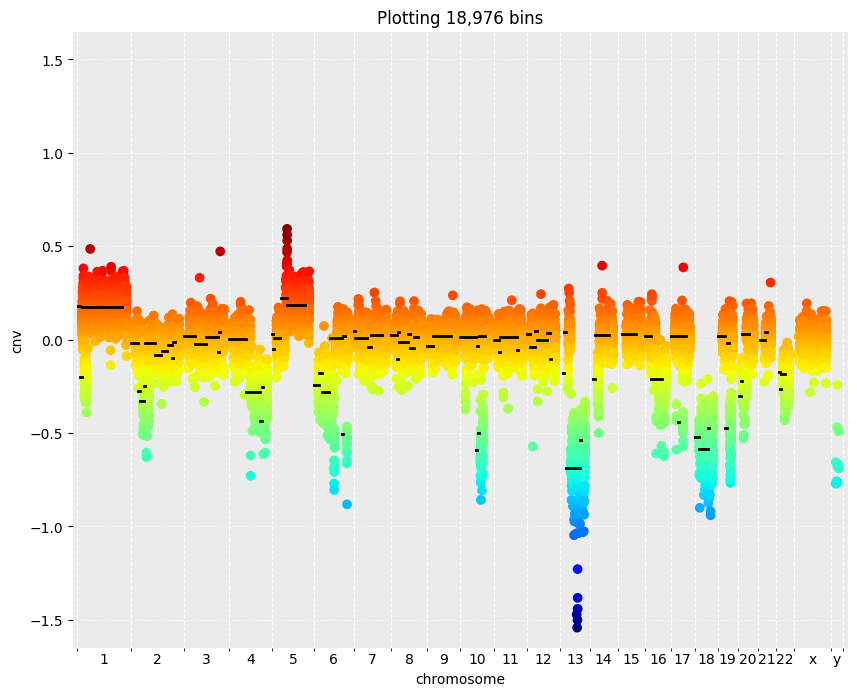
4.3. Visualize CNVs and segments
Plot the identified segments and CNV values
[5]:
manhattan_plot_cnv(signal_bins_df, segments_df)